Friday, February 17, 2012

Maggie L. Walker National Historic Site

The Maggie L. Walker National Historic Site is a venue that is relevant to today’s society because her home offers a special inspiration to entrepreneurial women and the African American community as well as other visitors who wish to expand their social and cultural horizons. This old and incredibly maintained home from the 1900’s in Richmond’s Jackson Ward neighborhood is marked by incredible splendor: 28 rooms, gas electricity, and even an elevator to emphasize the owner’s wealth. You might be surprised to hear that this home belonged to a woman, and a black woman at that. The Jackson Ward location is a symbolic landscape to the historical site because it was the only district in Richmond where Blacks owned companies, dominated institutions, and were not accustomed to slavery. This exciting and colorful neighborhood was the most prosperous of black communities during the early 1900’s and the birthplace of African American entrepreneurship; it is even referred to as the “Black Wall Street of America.” It is no wonder that Maggie L. Walker was the face of this community because she perfectly embodied the industrious and hopeful attitude that has come to describe Jackson Ward today.


The museum’s neighborhood layout provides a lived experience by including each visitor in Maggie’s lifestyle and family customs. She is remembered not only in Richmond but also through out the entire history of Black activism in the United States. As a visitor, being present in this remarkable woman’s home, where she resided 50 years ago and experiencing the restored rhetorical artifacts of her life, helped me understand how impressive Maggie Walker’s accomplishments truly are.

Maggie’s home itself is the most important exhibit of the historical site. The technological advancements that were made during the late 1800’s and early 1900s really struck me. Museum visitors see how sections of her house were converted from gas to electrical, such as the fireplace, heating system, and kitchen stove, yet in the upstairs bedrooms, we see candles lit as a source of light. The combination of personal objects, such as photo albums, exquisite artwork, and even the fine kitchen silverware that serve as the décor in Maggie’s home explained to me her success during a difficult time. These objects, although discrete, emphasized Maggie’s role in the home.


I joined an hour and a half long tour and the park ranger honored the importance of Maggie’s achievements, family life, and education. In a dull voice, he spoke from a historical standpoint and discussed Maggie’s establishments: the bank, emporium, and newspaper. Each one is placed in great historical context through out the museum but can also be understood rhetorically thus helping me to imagine Maggie’s life. A bank is generally seen as a place where money can be stored but Maggie’s bank was special because it invited blacks in the community to congregate and regain courage to continue fighting for desegregation. By putting her own money into the bank, inviting choirs to perform, and activists to speak there, she took a selfless approach and contributed to the community’s well being. It is important to note that she was the first black woman living in the US during the early 1900s to not only establish a [successful] bank but to withhold its presidency for her entire adulthood. Her motto, “let’s have a bank that will take the nickels and turn them into dollars,” I believe reflected her desire to impact change for all groups of people discriminated against, including blacks and women in the 1900s.


The park ranger, who led my tour around the national historic site, reminded me of a virtual encyclopedia. He repeated facts about Maggie’s life in a monotone voice, which made it hard to keep up with his fast dialect. Although he could have emphasized this a bit further, Maggie’s appreciation for education reflected her success in life. In her living room, I admired Maggie’s diplomas and educational awards that hang on the wall. This physically showed me how important education was to her. As a child, most of her peers did not have the luxury of learning how to read and write, but Maggie’s skills in both fields helped her plot the various businesses that she began in her early life. She even took classes on how to run a business to make the organizations she worked for successful and without this education Maggie would not have been as multidimensional as she was. The bank, which originally was a small organization, turned into a business of 100,000 members. During this time, education was a luxury to have, which my tour guide neglected to speak about. I think he could have explained to us the correlation of education during segregation to emphasize how accomplished Maggie’s establishments were.

As Maggie grew older she had to over come many obstacles. She not only became paralyzed in her old age but her eldest son accidentally killed her husband, when mistaking him for a neighborhood burglar. Despite these tragedies, Maggie’s striking bravery carried on. She publically fought for civil rights and the rights of her community as a whole, which is continuously reflected at the museum. Maggie was a woman of determination, faith and devotion and her entrepreneurial successes continue to inspire to African Americans and other women who are struggling for power today. Before arriving at the site, I read about Maggie Walker and had prematurely concluded that she was a wealthy woman who was lucky to have not been born into slavery. However, after leaving the site, my perception changed and I now believe that because of her appreciation and use of her education, she changed the reputation of the black community in the 1900s. Maggie Walker’s spirit lives on in Richmond and for African Americans facing inequality in their institutional settings.

Monday, February 13, 2012

Virginia Historical Society- The Story of Virginia


The Virginia Historical Society, located next to the Virginia Museum of Fine Arts on Boulevard, has been showcasing Virginia history and artifacts for decades. I examined The Story of Virginia exhibit, which displayed over 1,000 artifacts dating back to their earliest parts of the 15th century. When entering the exhibit you find yourself viewing a brief video that offers a general timeline of Virginian history and the background of what the exhibit entails. The entrance is a log cabin construction with a feeling of Jamestown, pictured here 


I felt the introduction was conveyed in a unique way in regard to the focus of the video. Throughout the timeline significant events are mention and showcased, such as Native Americans, the establishment of Jamestown, the rich Presidential history, our growing infrastructure and technology, and the beautiful landscape of Virginia. Although numerous historical events were featured in the film, the incorporation and focus of African Americans was not only a highlight of the film but received a great deal of focus. After viewing the video it seemed that a great deal of the exhibit would highlight the Civil Rights movement and the struggle of African Americans in Virginia to gain racial equality and overcome the grips of segregation. Overall I felt that the video was visually dynamic and offered many insights that gave even the most knowledgeable historian a detailed explanation and background on the purpose and aim of the exhibit.

The exhibit is broken into numerous time periods throughout Virginian history, which are displayed in a series of rooms as one walks through the spacious exhibit. The time periods are labeled as such; Becoming Virginians, Becoming Americans, Becoming Southerners, Becoming Confederates, Becoming New Southerners, Becoming Americans Again, Becoming Equal, and finally Becoming a New Virginian. The exhibit starts by focusing on the Native Americans and displays original arrowheads, tools, weapons, and canoes, pictured here


Although the story of Native American’s transitions into the establishment of Jamestown and the American Revolution, the exhibit focused on the Native Americans as a people and culture and failed to acknowledge their displacement by the English settlers.

The Becoming Americans and Becoming Southerners sections were the most relevant to one’s opinion of Virginia history because these sections incorporated the rich Presidential traditions, the foothold in rebelling against Great Britain, and the powerhouse of the Confederacy. Artwork was prevalent throughout these sections as battles, portraits, and the Richmond skyline were the center of attention. I personally felt this section was lacking a more detailed history of Richmond as the capital of the Confederacy and it seemed the primary focus was of the Virginian Presidents. Furthermore, the artwork and paintings were somewhat boring and did not fill the space as dynamically as other sections throughout the exhibit. The presentation implied that these two sections were the highlights of Virginia History but the presentation fell short for their aim.

One of the more exciting displays and time periods in the exhibit was the Becoming Equal and Becoming a New Virginian. These sections incorporated the most detail and artifacts as they focused on the era of the Civil Rights movement, expanding technology, and the changing cultures in Virginia. As the video stated at the beginning of the exhibit, African Americans received much attention throughout the time period of the Civil Rights movement and numerous rooms were dedicated to displaying artifacts that showcased their struggle and eventual acceptance in equality. I felt that this section was the most powerful because it leaves the viewer with a powerful account of the experiences of African Americans at the time. Pictures offer a firsthand account of the segregation and struggles that were so prevalent in Virginia, especially Richmond. For me personally I felt that this display was alarming and sad because I saw the segregation taking part in my home town. After seeing the firsthand accounts right in my back yard I gained a different perspective for the African American’s struggle for equality.

Relating to this time period, the later part of the decade incorporates the expanding technology and culture that Virginia was experiencing between the 60’s and 80’s. Magazines, records, clothes, and transportation show the progress of lifestyle during this period and a feeling of nostalgia is eminent for those who experienced this period as a child. 


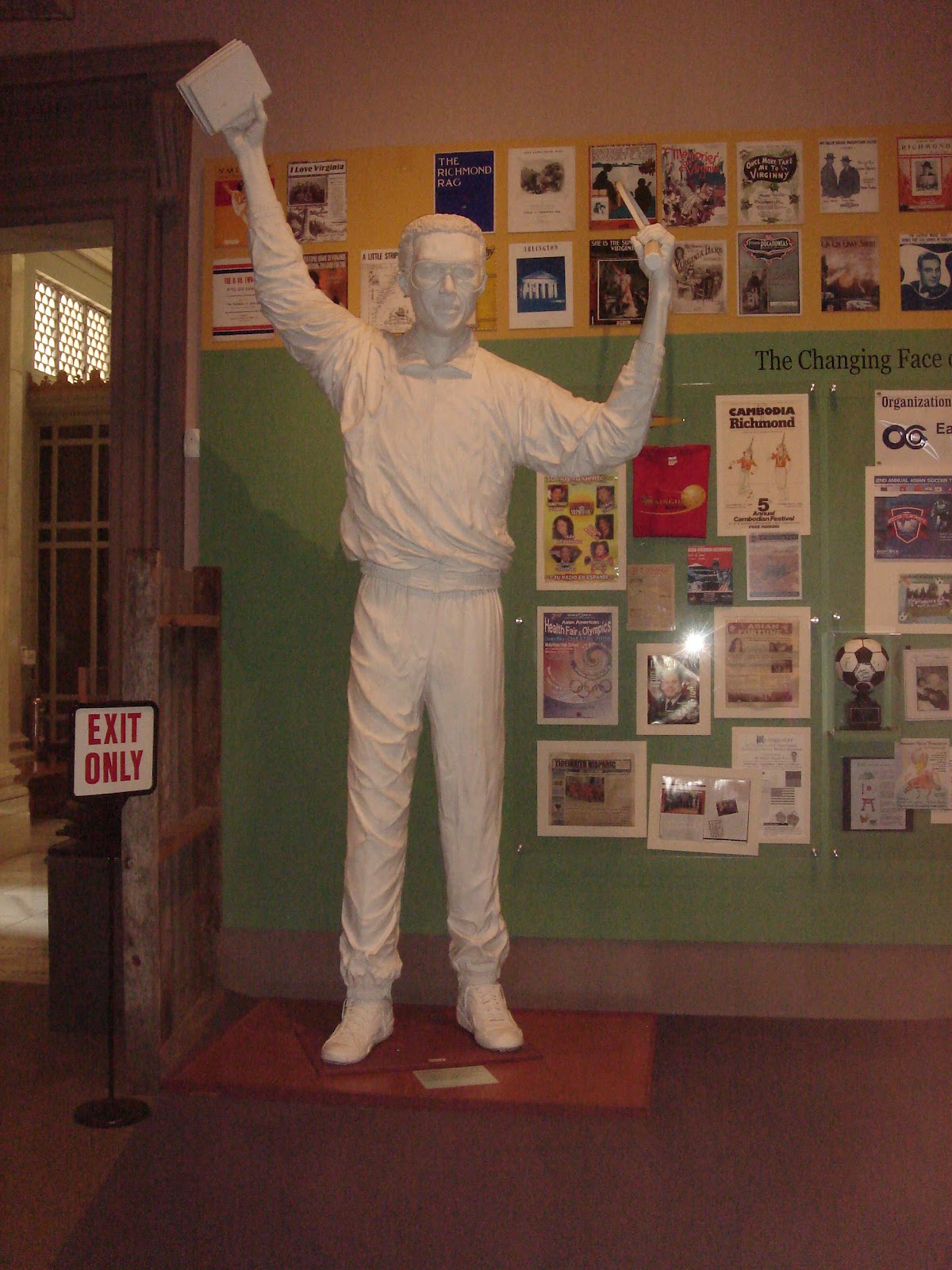
Personally I felt this collection was not only neat but the visual overload gave you a sense for the expanding pace of life as technology sped up not only the workforce but our culture as well. Music and sports were highlighted throughout the time period with the exhibit ending with a prominent and influential statue of Arthur Ashe, pictured here


I thought the exhibit ending with a 15 foot tall statue of Arthur Ashe was not only interesting but controversial. Yes he means a great deal to Virginia History and played a large role in the expansion of sports to African American communities and AIDS awareness but it seems the exhibit is portraying him as the most sacred piece of Virginia History. The dominating statue is larger than life, which suggests his character and life; however, to incorporate a statue of Arthur Ashe of this size and to end the entire exhibit with him looking down on you as you exit is significant to the viewer’s takeaway. From the opening video to the final statue, it seems that the exhibit comes full circle with the primary focus and statement of African American’s in Virginia. I think the exhibit should have certainly incorporated this side of Virginia History but I feel that the other events, individuals, and cultures are tainted because the exhibit suggests that the establishment of African Americans in Virginia is the most significant and important element of our history. Overall I enjoyed the exhibit and the presentation of artifacts. The title of the exhibit is The Story of Virginia, and the Virginia Historical Society made a great effort in constructing such a detailed account of Virginia. Although the exhibit is targeted to a more mature audience, I think we can all gain an appreciation for Virginia History after viewing their extensive display of artifacts.  

Tuesday, February 7, 2012

The Museum of the Confederacy

The Museum of the Confederacy, placed adjacent to the VCU hospital, is a quiet, three floor, three exhibit, and unfortunately run-down building in downtown Richmond. After taking note of the lack of aesthetic appeal and serious absence of interactive opportunities for the visitor, I decided it would be best to focus on the museum’s main exhibit, titled “The Confederate Years: the Southern military in the Civil War” which claimed to be a year by year introduction to confederate military history.
The exhibit begins with two posters of text with the questions “Why secession? Why war?” and “Why did they fight?” It is clear the curators want to clear the air about what ignited the civil war and the creation of the confederacy, something debated and intensely discussed in the historical community. The answers written below these questions tend to lead the visitors to believe that the South had no other choice but to take action. Also, the answers tend to stray from the dispute over slavery.

“While the political and constitutional struggle over slavery caused the breakup of the Union, the men who filled the ranks of the Confederacy’s armies rushed to the colors for reasons not related directly to slavery...[they] were fighting for the rights and liberties that their forefathers had won in the first American Revolution.”

This claim exonerates the soldiers. They are no longer represented as fighting for what is seen today as an inhumane and prejudicial practice. This characterization of the soldiers sets the stage for the remaining parts of the exhibit, which memorialize, celebrate, and sanctify the generals and commanders of the Confederate military.


The following room involves a wall with the portrait, name and accomplishment of the generals and commanders. The information includes date of birth, education, and important battles fought. If he had died during battle, the description would mention his heroic contribution to the struggle against the north. There are many artifacts belonging to these men placed in cases, organized by battle chronologically. Uniforms, flags, drums, guns, binoculars, swords, saddles, horns, and even compasses are labeled with which soldier each item belonged to. By glorifying these items, which are typical of truly any military during that era, the men become celebrities. The exhibit expects the viewer to be enamored by such a simple object due to its owner. This is especially evident in the case dedicated to Robert E. Lee’s camp.


This particular display covered an entire wall in one of the rooms, making it one of the major focal points of the exhibit. The description claims that all of the items belonged to Lee and noted that for such a prominent commander, his living quarters were quite simple.

“Robert E. Lee was very conscious about living better than his men.”

Lee is not only depicted as one of the most important commanders, but he is also characterized as a man of integrity and compassion.
            Aside from the characterization of the generals and commanders, the cases representing each battle have two noteworthy aspects, their size and their description. There is a continuing theme in the description of the Confederacy’s lost battles. The majority of the text describing the event focuses on bad weather conditions, a surprise attack, a lack of man power or other excuses and finally two or three sentences about the outcome. For the visitor, who is likely interested in whether the battle was won or lost, the process of reading drawn out introductions can be overwhelming and unnecessary.
            The different sizes of the cases are very telling of the exhibit’s purpose to celebrate Confederate battles won rather than those lost. An extremely small case set in the corner of a room describes the Confederate defeat at Fort Donelson.

“The defeat resulted in the greatest loss of territory that the confederacy suffered in the war.”

This case could easily be overlooked by many museum goers, suggesting the possibility that the purpose of the exhibit would not be to give equal historical accounts of all battles but to downplay major losses. A second example of this could be the Fall of Richmond exhibit, also in a smaller case than others and set in the corner of the room.


In contrast to the Fort Donelson and Fall of Richmond displays is the extremely large case about the Confederate Calvary.

“Although the claim that southerners were better horsemen and marksmen seems like a sectional stereotype, modern historians affirm that Confederate Calvary was distinctly superior.”

The magnitude of the case in comparison to others coupled with the claim of the Calvary’s superiority are evidence of the exhibit’s main focus on Confederate successes.
            Finally, the last case in the exhibit is about Jefferson Davis and his family’s capture. Rather than ending with the last battle, which would seem most appropriate considering all previous cases had been filled with military content, the final case made the exhibits last attempt to praise the Confederate army and cast it in the shadow of success, regardless of a loss the audience knows to be inevitable.

“The Confederacy’s survival depended on its armies, but the collapse of the Confederate government made further military resistance pointless.”

This quote, reflecting the beginning claim that the men were fighting for more than slavery, exonerates the soldiers in a different way. It takes the blame for the Confederacy’s loss off of the shoulders of the military and puts it on the government. Depicted in the case is a cartoon of Jefferson Davis who was rumored to be wearing his wife’s petticoats when captured, he museum description calls them “slanderous cartoons,” and a statement above it from an eyewitness stating that the rumor was false.


Although the purpose of the exhibit claims to be to be a year by year introduction to the Confederate military history, the exhibit speaks too loudly towards the military successes and too quietly towards the defeats, leaving the visitor feeling sorry for the museum’s attempt to glorify the Confederate army rather than offer a history. 


Monday, February 6, 2012

Black History Museum and Cultural Center of Virginia

    For much of my youth education I was taught about slavery and the civil rights movement as a time through which the black population in this country suffered. Black history in America seems to be one riddled with anger, frustration and oppression. Textbooks and teachers explain black history with a heavy heart and tell tales of abuse and white-man dominance. As I traveled to the Black History Museum and Cultural Center of Virginia these were my expectations, but I was to be very wrong.
   Tucked away on the back roads down by VCU is a small row home that houses one of the few repositories for visual, oral and written records of the black experience, as stated by the museum. It is completely unassuming and it would be easy to stroll by without ever knowing it contained such a rich story of the city’s past.
   Entering the row home you are quickly greeted by an employee and led to a small bench where a ten minute video is played to introduce you to the content and purpose of the museum. The video explains the creation and development of the Jackson Ward, which the video said was one of the first settlements for black people. Although the museum says it covers the black experience in Richmond from 1700 through the 1970s, you quickly learn what the exhibits are going to highlight based on the video. Of the ten minute video, 9 minutes and 50 seconds were spent recreating the golden years of the 1940s and 1950s in the Jackson Ward. This tunnel vision view of the Jackson Ward is continued all throughout the museum.
   Although there isn’t a written statement about the purpose of the museum anywhere in the actual museum, the brochure gives many blurbs about what the museum is looking to accomplish.
“Today, the museum is a celebration of the human spirit and a testament to what people can achieve when they are faced with adversity.”
This quote is important because it sets the mood for many of the exhibits. I was expecting my time at the museum to be full of sorrow and anger at the sad history of the black experience in Richmond, but the overwhelming sense I got as I walked through the exhibits was that it was a highlight reel of the black experience. Some of the titles of the exhibits were “United We Stand,” “Champion of the People,” “Independent Business Owners,” Strengthening the Black Dollar,” “Birthplace of Black Capitalism.” There was an impressive sense of black pride and independence that I wasn’t expecting when I first arrived.
     The overarching question I think the exhibit is addressing is: what was life like during the glory days of the Jackson Ward? Although I doubt that is what the museum wants the visitor to believe because it is said to cover more than 200 years of history, there is so much emphasis put on this time period that the exhibits seems only to produce one feeling during one chunk of time.
     The museum is very simply organized and easily navigated. Because it is a row home, it is rather small. It is a two story building that features a constant exhibit downstairs and a rotating exhibition system upstairs. The right side of the first floor is the front desk and gift shop, leaving the left half of the downstairs for the actual exhibits. The initial exhibits set up the clear theme of black success and establish the sense that the Jackson Ward was the place to be for black people. Throughout the explanations on the walls of the artifacts featured, the Jackson Ward area is referred to as “The Black Mecca,” “Little Africa,” “The Harlem of the South,” “The Golden Era.”
     Every exhibit in the museum glorifies the black experience. Rarely are there references to hardships or struggles past a fleeting mention of segregation or Jim Crow laws. In fact, the Jim Crow laws and segregation are displayed as the catalysts for the boom of the Jackson Ward. “A city within a city” was created from the separation of whites and blacks. Instead of showing the troubles, the exhibits feature the independence earned. I think this is indeed an area of great concern because if I didn’t know more about Jim Crow laws and how degrading this time was, I wouldn’t think it was all that bad. They are doing a huge disservice to the community by downplaying such a horrific time.
     The 1920 census found that 93% of Richmond’s African American population lived in Jackson Ward. The video and exhibits center on this population and tell the story of a very active and high-energy area. Restaurants, flower shops, barber shops, real estate agencies, all owned by black people were the core of the exhibitions. The 1950s were a time when all black people wanted to be on 2nd Street because of the parties, entertainment, music, theaters and drinking that was going on. Celebrities like Willie Mays and Joe Lewis frequented the area and soldiers from all over the country poured in to get in on the action of Jackson Ward. This is the story of the museum. The exhibits were about black independence and business ownership, parties, schools and successful black people.
  It is clear the museum’s goal is to celebrate the success of black people and recreate a time that was lively and free, but I think this is a dangerous goal. The museum is so heavily and obviously focusing on such a limited time frame it is impossible to believe this is what the black experience in Richmond was like. Nowhere is there the story of hard times or unfair treatment. Any type of confrontation or dark spot is quickly noted then passed and overshadowed by an achievement. Although I can understand the desire to portray such a vibrant time in the city’s past, I just cannot understand how the museum can show so little toward the greater history of the black population.


Rachael Bilney

Tuesday, January 31, 2012

Black History Museum and Cultural Center 

The Black History Museum and Cultural Center in Richmond, Virginia is located within one of the original neighborhoods where Richmond's historically black community began to take form. From the street, the brick building stands from the other buildings around it, with its four large pillars framing the entrance to the museum. Upon arrival, visitors watch a video that sets the tone for the rest of the exhibit. The video previews the history of Richmond's black community which contextualizes the displays and artifacts included in the exhibit. The video features commentary by black Richmond natives which infers that the museum tells its narrative the way the people of the community want it to be told. Upbeat jazz music is played in the background which sets a celebratory tone.

The video at the beginning of the exhibit is an important element that explains the purpose of the exhibit, which is to proudly reflect on and honor the achievements and history of Richmond's oldest African American community. The video aligns with the structure of the exhibit and is used to preview the questions that guide the exhibits structure. These questions include, what is the history of Richmond's oldest black community? What is the significance and impact the community locally and nationally? Who and what were their major contributions and how did they fit into American history as a whole?

The exhibit, titled “Banks, Boutiques and 'The Deuce': The Legacy of Jackson Ward,” chronicles Richmond's historically African American community, Jackson Ward. Jackson Ward has been described as the “hub of Black Capitalism,” “the cultural mecca of black society in the South” and “the Harlem of the South.” The exhibit tells the story of how Jackson Ward gained its notoriety and how it fit into the historical landscape of the United States in the 19th and 20th centuries. 

The exhibit is organized chronologically, starting in the mid-1800s when the first black community in the city of Richmond began to take shape. Each section of the exhibit has a title which is representative of its specific time period, starting with “The Birthplace of Black Capitalism.” Black capitalism is the most significant theme throughout the exhibit as Jackson Ward is known for and proud of its astounding economic achievements. This section includes artifacts such as documents, books, awards, newspapers and pictures of notable members of the community. The historical context of each section of the exhibit is of great importance. The economic success of Jackson Ward as an African American community in the South was unprecedented at the time. The original members of Richmond's African American community were newly freed slaves who relocated to Richmond following the Civil War. The exhibit pays respect to the people who inhabited the neighborhoods and built a business community from the ground up.

The subsequent section, titled “Independent Business Owners,” displays artifacts from businesses started in Jackson Ward such as eye glass stores, and barber shops. It also recognized the entrepreneurs within the community. 

As the exhibit moves on to the 20th century it addresses how the Civil Rights Movement impacted Jackson Ward. This section is titled, “Separate but Equal?” and highlights people from the community who challenged separate but equal. The narrative discusses how people from Richmond played an important role in contributing to the success of the Civil Rights Movement. This section honors two African American lawyers from Richmond who worked on one of the five cases that set the precedent for Brown vs. Board of Education. This section, like the exhibit as a whole, portrays Jackson Ward as a community that made significant contributions to the progress of African Americans in the United States.

After contextualizing Jackson Ward within the history America, the exhibit focuses on the culture of the Jackson Ward community. The section titled, “United We Stand” addresses the importance of the church within Richmond's black community. The display calls the church “the backbone of black society,” and includes photographs of the first churches and a description of the church's role within the community in the 19th and 20th centuries.

The exhibit's final section, “Let Me Entertain You,” continues to display important aspects of the community's culture which discusses how the entertainment within the neighborhood shaped the culture of the community, which came to be known as “the Harlem of the South.” The display explains how shops, restaurants, beauty parlors and hotels contributed not only to the economic success of the community, but also to the cultural importance of Jackson Ward. Photographs of the renowned entertainers who spent time in Jackson Ward, including Duke Ellington and Ella Fitzgerald. Certain buildings within the community also contribute to the community's culture. The well known Hippodrome theater provided a location where artists and spectators could gather for performances. Entertainment was said to be the heart of Jackson Ward, and the artists and establishments within the community caused Jackson Ward to be known for its artistic and cultural contributions, as well as its economic contributions.

The exhibit initially explains the national significance of Jackson Ward which draws in the viewer by proving its importance in United States history, then details the more specific culture and accomplishments of the community. The exhibit celebrates the success of the community as a whole within the context of the time. The exhibit mentions that compared to the white community in Richmond, Jackson Ward would be considered less successful, therefore, the exhibit must carefully contextualize the community within the South for viewers to understand how impressive Jackson Ward's achievements are. Overall, the Black History Museum and Cultural Center of Virginia narrates the origins, contributions, setbacks and culture of Richmond's oldest African American community the way in which the people of Jackson Ward would want it to be told.